WriteText.ai 4.5 is here: expanded alt text coverage, default templates, and more. See what's new.

WriteText.ai 4.5 is here: expanded alt text coverage, default templates, and more. See what's new.
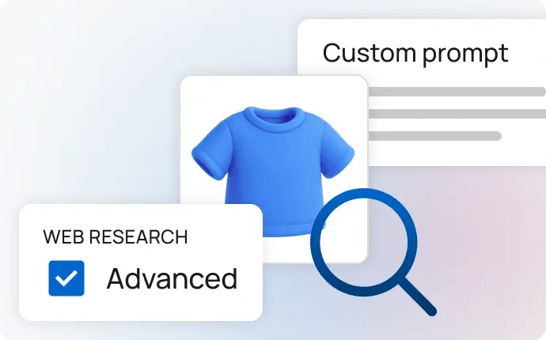
Product data enrichment is the process of improving and expanding your existing product information to make it more complete, accurate, and useful for customers. For ecommerce, that means going beyond raw backend data to produce listings that are detailed enough to inform purchase decisions, rank in search, and drive conversions.
WriteText.ai handles this automatically at the point of content generation — pulling from attributes, product images, and the web so no manual research or data entry is required.
WriteText.ai layers multiple data sources to produce enriched product content in a single generation step. Web research runs first (if enabled), followed by image analysis (if enabled), then user instructions and inputs, then product attributes and meta keys (as available). Web research and image analysis supplement your data, they do not overwrite it.
Even products with sparse backend information can result in rich, accurate, and conversion-focused listings. WriteText.ai fills the gaps using AI image analysis and real-time web research, so every product page feels complete and professionally written — without manual research or guesswork.
Attributes and Post Meta fields are automatically pulled from your store and treated as a source of information in generation. Whatever is there gets used — and whatever is missing gets filled in through image analysis and web research.
The featured image is analyzed using AI image recognition to extract visual details like materials, finishes, textures, and shapes. When backend and supplier data are thin, the image becomes a data source in its own right — contributing details that would otherwise be missing from the enriched content.
For products with details not covered by standard attributes, you can input additional information before generating. That context is factored in alongside everything else.
Using templates, you can create entirely new content sections that do not exist in the default, each driven by its own prompt. Examples include care guides, material breakdowns, sustainability information, compatibility notes, and technical highlights. Each custom section has its own research level setting: None, Basic, or Advanced, so you control how much external data goes into each one.
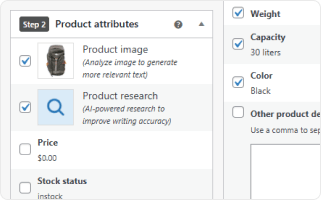
WriteText.ai scans your store's backend for all available product data and lets you select what gets included in generation. This covers attributes like price, weight, size, and other product details, as well as product tags. Structured backend data is the most reliable enrichment layer because it comes directly from your own records, but image analysis and web research can compensate for poor or missing data.
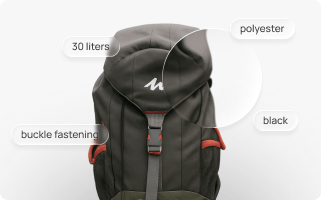
The featured image is analyzed using AI image recognition, pulling out details that may not appear in any of your product data fields. Textures, colors, shapes, finishes, and visible product features are all extracted and used as inputs. This is especially useful when supplier data is incomplete or the product name does not describe the product (for example, "XG-42" for a B2B machine part) — the image gives the AI additional context to produce accurate enriched content.
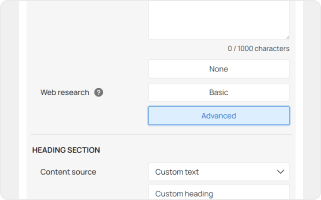
Web research searches the web in real time for current, credible information about the product, including specifications, use cases, materials, and compatibility. Rather than relying solely on your backend, the AI reaches outside your catalog when needed. This feature is optional and particularly useful when attributes and Post Meta data are poor or missing.
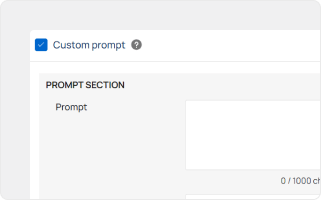
Using WriteText.ai's templates, you can add content sections powered by your own prompts. Each custom section supports three web research levels: None, Basic, or Advanced, so you define both what the section covers and how much external data goes into it. This gives you structured control over content types that are not covered by default sections.
WriteText.ai uses image analysis and real-time web research to produce complete, enriched product content — even when your current catalog data does not cover everything.
User instructions and structured attributes always take priority, so web research supplements your data rather than replacing it.
Enrich and generate content across thousands of products without touching each one individually.
Produce detailed, enriched listings for freshly added products even before their full attribute data has been entered into your backend.
Set research levels individually for custom template sections to balance accuracy, content depth, and credit usage across different product types.
Your catalog does not need to be complete before you start generating content. WriteText.ai reads what is in your store, analyzes the product image, and researches the rest in real time — so the work of gathering and applying product information is handled for you. As an AI product description generator built for ecommerce, it produces accurate, detailed content directly inside WooCommerce regardless of where your catalog is in terms of completeness.
WriteText.ai treats your backend product attributes as the authoritative source of information. Web research supplements what is already there, filling gaps where attribute data is missing, rather than overwriting what you have entered. If your attributes state a specific weight or material, the generated content will reflect your data. The web research layer adds context and additional detail for areas your attributes do not cover, such as use cases, compatibility, or care instructions.
Yes. We can integrate WriteText.ai with proprietary platforms through our API and development services
Product data enrichment is applied during content generation sessions rather than automatically in the background. When you generate content for a product, you choose whether to enable image analysis and web research as part of that run. The enrichment layers are optional inputs that you activate per session, giving you control over when external data sources are used and for which products.
Yes. WriteText.ai can generate enriched product content for items with minimal backend data, including products that have only a name and no configured attributes. In this scenario, image analysis and web research become the primary data sources. A clear product image and a recognizable product name give the AI enough context to produce accurate and detailed content. The more the product name and image convey about the item, the more specific the enriched output will be.
Web research is particularly useful for surfacing information that is rarely entered as a structured attribute, including compatibility with other products, care and maintenance instructions, sustainability credentials, technical certifications, common use cases, and historical or brand context. For products in technical categories, such as electronics or tools, research can retrieve specification details that are not always captured in a standard attribute set.
Yes. Web research is an optional input that you enable per generation session. If you want to use web research for products with sparse attributes but rely only on backend data for fully attributed products, you can run those as separate generation sessions with different settings. When using templates, each custom section has its own research level setting, giving you granular control over how much external data goes into each part of the description.
Yes. Web research is particularly valuable for B2B products where the product name may be a part number or model code that means little to a general audience. WriteText.ai can research those identifiers in real time to retrieve technical specifications, compatibility data, and use case information. The AI image analysis layer also helps by extracting visible features from product photos, which is useful when a product's name alone does not describe what it is.